.png)
.svg)

Every month we share our insights on relevant industry trends, resources to support founders, exclusive interviews and top news from our portfolio.
Scaling in Africa: What Founders Get Wrong After Product-Market Fit
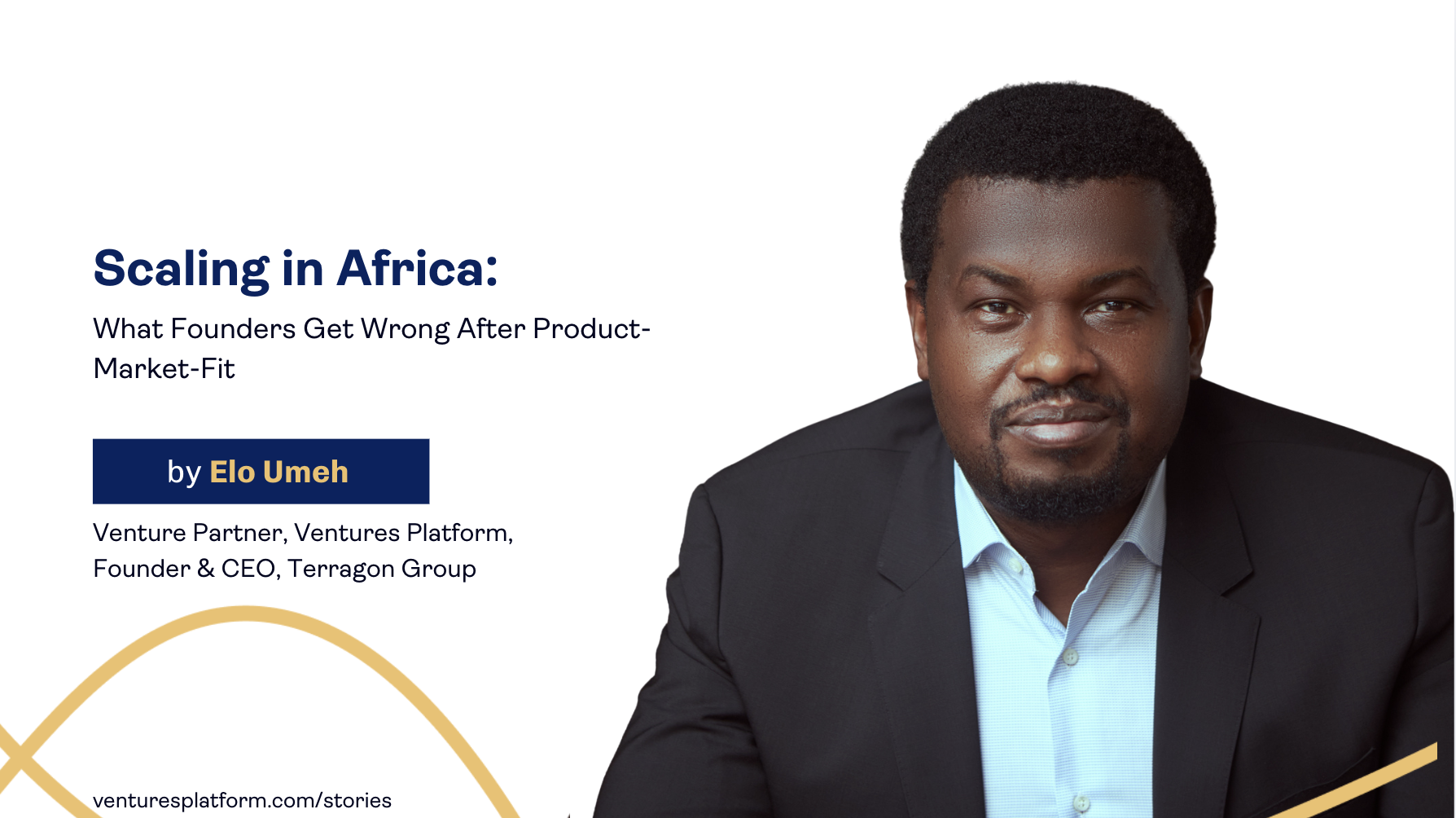
For many founders, product-market fit feels like the finish line. In reality, it marks the beginning of an entirely different challenge.
The transition from early traction to repeatable, sustainable growth is where many startups begin to stall. What worked to win the first thousand customers rarely works for the next hundred thousand. Founder instinct must give way to systems. Early momentum must be supported by disciplined execution, sound economics, and an organisation capable of delivering value consistently. Yet much of the conventional wisdom around scaling has been shaped by mature markets with stronger infrastructure, richer consumer data, and more predictable operating environments. For African founders, building at scale requires a different playbook.
To explore what founders often get wrong after product-market fit, and what it really takes to build companies that endure, we spoke with Elo Umeh, Founder and CEO of Terragon Group, and a Ventures Platform’s Venture Partner. Drawing on more than two decades of building technology businesses across Africa, he shares practical insights on scaling sustainably, building institutions instead of founder-dependent businesses, leveraging first-party data, and making strategic decisions that create long-term value.
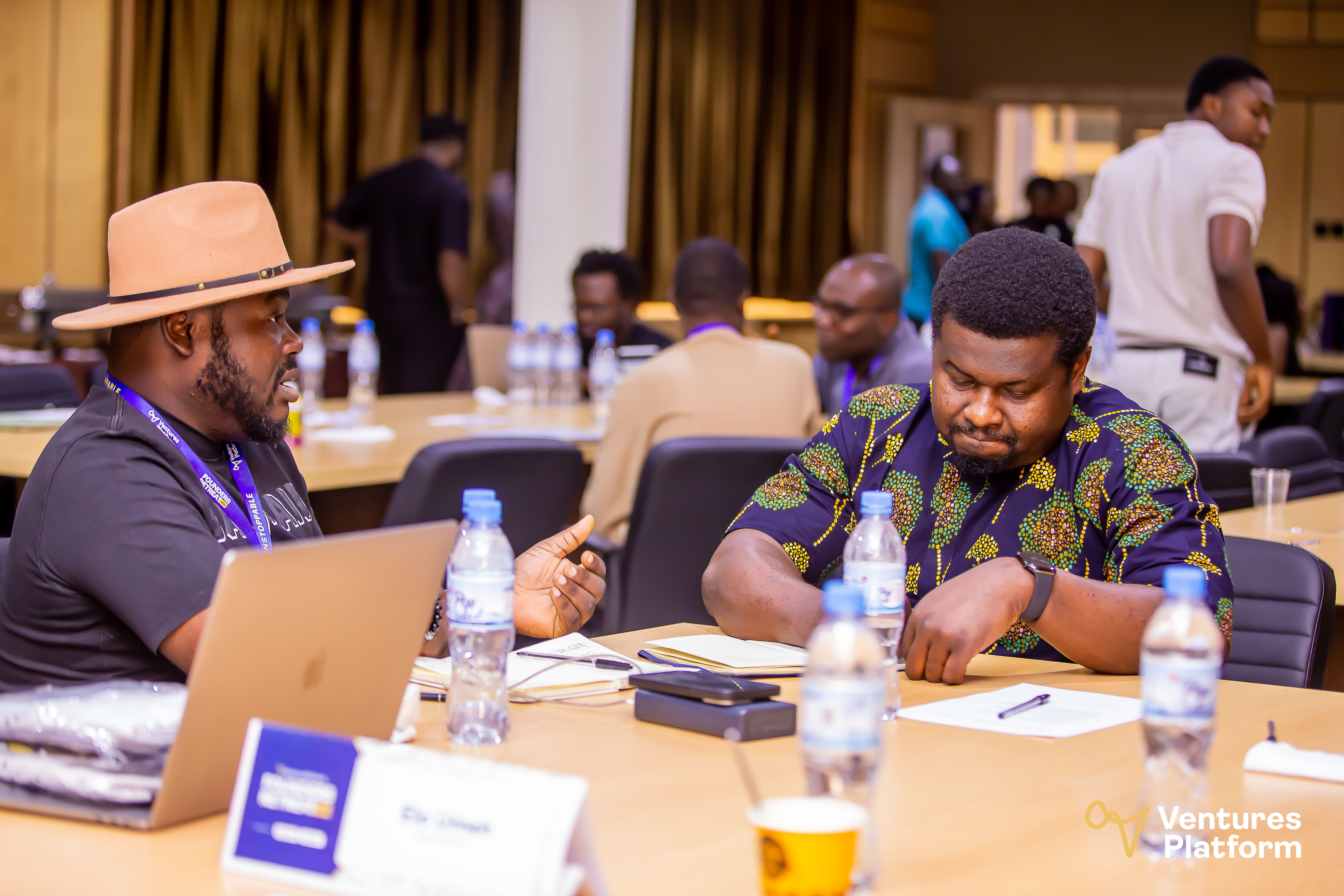
In this Q&A, Elo unpacks the warning signs that a business is scaling too soon, the operational disciplines founders often overlook, and the mindset shifts required to move from momentum to enduring growth.
- Reaching product-market fit is genuinely hard, but the assumption that follows, that scaling is largely an execution challenge once PMF is achieved, is where many founders run into trouble. In African markets specifically, where consumer behaviour, data availability, and infrastructure differ significantly from Western benchmarks, what are the clearest signs that a company hasn't truly built for scalable growth, even if it appears to have traction?
Elo: I think the first mistake is equating traction with a company that is ready to scale. Traction proves that you have created value for a group of customers. It does not necessarily prove that you have built the organisation, economics and infrastructure required to reproduce that value sustainably.
Building a product is different from building a company. A product can work because the founder is personally driving sales, resolving customer problems and holding the entire operation together. A company, however, must be able to deliver the same value repeatedly through its people, processes, technology, culture and partnerships.
One of the clearest warning signs is when growth still requires heroics. If every important sale depends on the founder's relationships, every customer requires a different solution, or every operational problem must be escalated to one person, the business has not yet built a repeatable engine. It may be successful, but it is not yet scalable.
Another warning sign is when founders don't fully understand the fundamentals behind their growth. They may point to downloads, transaction value, registered users or revenue, but the more important questions are: Who is the real customer? Why do they stay? What does it cost to acquire and serve them? How much cash does the business generate from that relationship? And does that behaviour repeat across customer cohorts?
Retention is especially important. If growth is being sustained by continuously replacing customers who leave, the company may have built an acquisition machine around a weak product. The same is true when demand depends heavily on discounts or incentives. Once those subsidies disappear, you quickly discover whether customers truly valued the product—or simply valued the subsidy.
In Africa, founders must also test whether their products work under real market conditions. A solution designed around constant internet access, modern smartphones, formal addresses, complete identity information or seamless digital payments may perform well among an early urban segment, yet struggle to reach a much broader population. The infrastructure assumptions behind the product are therefore just as important as the product itself.
Another common mistake is treating Africa as a single market. The continent offers tremendous scale, but it is fragmented across countries, currencies, regulations, languages and consumer behaviours. Success in Nigeria does not automatically produce a playbook for Kenya, Ghana or South Africa. The underlying principles may travel, but execution almost always requires local adaptation and strong partnerships.
For me, the real evidence of scalable product-market fit is repeatability. Can the company acquire, serve and retain customers with sustainable economics? Can it do so without the founder being involved in every transaction? And can it adapt its model to local market realities without rebuilding the business from scratch each time?
Until those questions are answered, traction should be treated as evidence of an opportunity, not proof that the company is ready to scale.
- Across your experience building and advising companies, what are the most consistent strategic or operational mistakes you see founders make once early traction is established - and are those mistakes different in African markets compared to what Western scaling frameworks typically warn against?
Elo: The most consistent mistake I see is founders beginning to dance to the music of other people. They see another company raise capital, expand into multiple countries or rapidly grow its headcount, and they assume they need to follow the same path. But every business is different. You cannot dance to another person's tune better than they can.
Founders must understand the fundamentals that drive their own business and remain focused on them. At Terragon, our products and business models have evolved over time, but the common denominator has always been mobile and the use of data and technology to create better connections between African consumers and businesses. That clarity has helped us distinguish opportunities that align with our long-term direction from those that are simply distractions.
A second mistake is expanding in too many directions after early success. Companies introduce new products, enter new markets and pursue multiple customer segments before proving that the original model is truly repeatable. This creates activity, but not necessarily value. Focus is not a lack of ambition. It is the discipline to know where your company can win.
A third mistake is raising and deploying capital without fully considering the company's fundamentals. Capital can accelerate a sound business, but it can also accelerate confusion. The amount a company raises creates expectations around enterprise value and investor returns. If the underlying market, margins and execution capacity cannot support those expectations, founders often end up creating distractions and solving problems of abundance, ultimately advancing unsustainable growth simply to justify their capital structure.
This is particularly relevant in Africa, where exits may take longer, capital markets are less liquid, and the cost of correcting mistakes can be high. Businesses must therefore be deliberate and responsible about how they capitalise themselves. Sustainable revenue, healthy cash generation and operating discipline remain important—even for venture-backed companies.
The broad strategic mistakes are not entirely different from those described in Western scaling frameworks. What differs is the environment in which African founders operate. Many Western models assume critical infrastructure already exists. Here, founders may find themselves having to build or enable payments, identity, distribution, logistics, customer education or data collection simply to deliver their core product.
That is why partnerships become essential. No company can own every part of the value chain. Founders must understand which capabilities are central to their differentiation and which are better delivered through a strong ecosystem of partners.
Ultimately, founders should resist the temptation to import a scaling template without first examining the conditions that made it successful. Market size alone is not enough. You must understand the local value chain, consumer behaviour, infrastructure, regulation and route to market. The goal is not to imitate another company's visible success, but to build a business whose fundamentals are right for the market it actually serves.
- You've spent over two decades building and scaling technology businesses in African markets where consumer data infrastructure is still maturing. How has operating in that environment shaped your thinking on the transition from founder-led, hustle-driven growth to building repeatable, system-led growth - and what do most founders get dangerously wrong at that inflection point?
Elo: Hustle is useful in the beginning - in fact, it is useful at every stage. Founders start with limited resources, incomplete information and no established organisation. Personal energy, relationships and speed help the business survive long enough to discover what works.
The problem begins when hustle becomes the operating system of the company. It should never become the core of the cell. I would encourage it to be an atom within several cells, but not the system that runs the body.
A founder can bring a vision or product to life, but building a company requires much more. You have to build the culture, governance, leadership, financial discipline and stakeholder relationships that allow the product to succeed sustainably in its target market. You must test, learn from failure, double down on what works, and enable different teams to work together effectively.
Many founders make the dangerous assumption that systemisation simply means hiring more people or buying more technology. But if the founder remains the only person who understands how decisions are made, the organisation has increased its cost without increasing its institutional capacity.
The founder has to transfer both knowledge and authority. The company needs clear priorities, well-defined decision rights, meaningful performance measures and consistent management rhythms. It also needs leaders who are better than the founder in critical areas—and who have the authority to do their jobs. I have had to learn that what got me to one stage of the journey would not necessarily get the company to the next.
Governance is equally important. It should not begin only when an investor demands it. A strong board helps founders see around corners, challenge assumptions and consider the long-term interests of the company beyond their own immediate perspective. The purpose of governance is not to slow a company down; it is to improve the quality and sustainability of its decisions.
In markets where external data remains incomplete, system-led growth also requires a deliberate first-party data capability. Companies must learn from every customer interaction across both online and offline channels. That data must be collected with consent, organised effectively and translated into better decisions. A dashboard alone is not enough if the underlying data cannot be trusted - or if the organisation continues to operate entirely on anecdote.
Ultimately, I think the deepest part of this transition is about purpose and leadership. A company cannot become an institution if it exists only as an extension of the founder's personal ambition. Founders must define why the organisation exists, the values that should endure as it grows, and how people experience its leadership.
Leadership ultimately comes down to service - how you enable other people to perform, grow and create value. The real test of system-led growth is not whether the founder becomes irrelevant. It is whether the founder has built a company whose success no longer depends on personal intervention in every important activity.
- In markets where mobile is the primary consumer touchpoint and formal data infrastructure is limited, how should founders evolve their customer acquisition and retention strategies as they move from early traction to scale? What approaches stop working, and what becomes non-negotiable?
Elo: The first thing founders must recognise is that mobile-first does not mean smartphone-only or app-only. Africa's mobile ecosystem includes smartphones, feature phones, mobile web, messaging platforms, SMS, USSD, and several assisted or offline channels. If a company defines its addressable market only by the channel it prefers to build for, it may unintentionally exclude a significant portion of its potential customers.
The right acquisition strategy begins with a deep understanding of the customer: the device they use, the quality and cost of their connectivity, the channels they trust, their purchasing power, and the context in which they make decisions. Technology must adapt to that reality—not the other way around.
As companies scale, broad, undifferentiated acquisition becomes less effective. The focus must shift from simply attracting users to identifying the customers most likely to activate, remain engaged and create long-term value. That requires stronger segmentation, greater personalisation and consistent measurement across channels.
Heavy incentives also stop working over time. Discounts and rewards may be effective in encouraging an initial behaviour, but they cannot substitute for a compelling product. If customers disappear once incentives are reduced, the company has rented activity rather than built loyalty.
Retention must therefore become a core part of the growth strategy. Founders need to understand how quickly customers experience value, which behaviours predict long-term engagement, and why different customer segments leave. Aggregate growth numbers are not enough. You have to examine customer cohorts and understand the complete customer journey.
Where formal consumer data infrastructure is limited, first-party data becomes non-negotiable. Businesses already generate valuable information through transactions, customer service interactions, websites, apps, forms, SMS and USSD. The challenge is connecting that information, turning it into meaningful insights and using those insights to continuously improve the customer experience.
This must also be done responsibly. Data protection is a gateway to trust in the digital economy. Customers should understand what information is being collected and how it is being used. Companies need strong consent mechanisms, security and governance—not simply because regulation requires them, but because trust itself is part of the product.
Partnerships also become increasingly important at scale. Telcos, financial institutions, distributors, device platforms and other ecosystem participants can provide access, data or infrastructure that would be expensive for a single company to build independently. Founders need to understand where they should own the customer relationship and where partnerships create greater value.
Ultimately, customer acquisition and retention should become one connected system. The objective is not to reach the largest number of people at the lowest headline cost. It is to identify the right customers, reach them through the right combination of online and offline channels, deliver value consistently, and build relationships that can be sustained over time.
- As both an active CEO and a member of an investment committee, when you evaluate a company that claims it is ready to scale - particularly within the African tech and consumer space - what are the non-negotiable elements you look for before believing that growth can be sustained? Is there a gap you consistently see between what founders present and what the business reality actually shows?
Elo: I always begin with the fundamentals. Does the company solve an important problem, and does it understand precisely who experiences that problem? Do customers return? Is the company creating economic value from serving them? Can that value be reproduced without an unsustainable level of founder intervention or subsidy? And how large is the opportunity?
The first non-negotiable is evidence of a genuine customer need. Market size and registration numbers alone are not enough. I want to understand what customers are actually doing, how frequently they use the product, why they stay and what alternatives they have.
The second is sustainable economics. Management should understand the full cost of acquiring and serving each customer, the contribution generated from that relationship, and the time required to recover the acquisition cost. Revenue growth without a clear path to healthy margins or cash generation can create scale without creating value.
The company's capital structure must also be appropriate. Founders should recognise that the amount of capital they raise creates a return expectation. If a business raises significantly more capital than its market or economics can support, it may become trapped by enterprise value expectations that force it to pursue growth at any cost. Responsible capitalisation is an important part of building a responsible business.
The third non-negotiable is people. Talent remains one of the greatest constraints in African technology. I look at whether founders can attract capable people, retain them, and build a leadership team that does not depend on one individual to make every important decision.
Fourth is evidence that the founders are building a company and not just a product. That includes culture, governance, financial controls, reliable systems, stakeholder management and a clear sense of purpose. A strong product may create an opportunity, but these surrounding capabilities determine whether that opportunity becomes an enduring institution.
Fifth is a credible route to market. The company should know which customers are most valuable, which channels reach them most effectively, and which partnerships are necessary to scale. If growth depends excessively on one founder, one customer, one platform or one distribution partner, then there is a concentration risk that must be acknowledged.
Finally, I look for humility and adaptability. Founders need conviction, but they must also be willing to challenge their own assumptions, learn from failure and evolve as markets change. Terragon itself has evolved significantly over the years while maintaining a consistent focus on mobile, data and intelligent customer connections. Staying focused does not mean remaining static.
The gap I often see is that founders present growth as an outcome without adequately explaining the mechanism behind it. The presentation highlights revenue, user numbers and a large market opportunity. The business reality, however, may reveal weak retention, heavy incentives, customer concentration, expensive operations or critical decisions that still depend almost entirely on the founder.
Before I believe a company is truly ready to scale, I want to know that its leaders understand the engine beneath the numbers. They should know what is repeatable, what is temporary, where the constraints lie, and how the business will create substantially more value than the capital it consumes. Scale should not simply make a business bigger. It should make the business stronger and more valuable.
.jpg)
About Elo Umeh
Elo Umeh is a pioneer and accomplished business leader with 20 years of experience driving innovation, digital transformation and the growth of the startup economy in complex and highly competitive markets. He has a proven track record advising Board and C-suite teams to achieve profitable and sustainable growth through strategic oversight, operational excellence and strong talent management. He brings deep expertise in building and scaling telecommunications, technology and data-driven strategies across Africa.
He is the Founder and Chief Executive Officer of Terragon. He also serves as an Adjunct Faculty Member at Lagos Business School in the Operations, Marketing and Information Systems Department, and a Venture Partner at Ventures Platform.
He contributes to several industry bodies including the Mobile Marketing Association in Nigeria, the Internet Advertising Bureau West Africa and the Young Presidents Organisation.
Umeh holds a Global Executive MBA from IESE Business School, where he graduated with honors and was recognized on the IESE Business School 40 Under 40 entrepreneurs list in 2017. He also holds a bachelor’s degree in Business from Lagos State University in Nigeria.
Author
Elo Umeh
