
.svg)
.png)
.png)
Every month we share our insights on relevant industry trends, resources to support founders, exclusive interviews and top news from our portfolio.
Unlocking Francophone Africa’s Startup Potential: How Founders Can Attract Capital in Underserved Markets
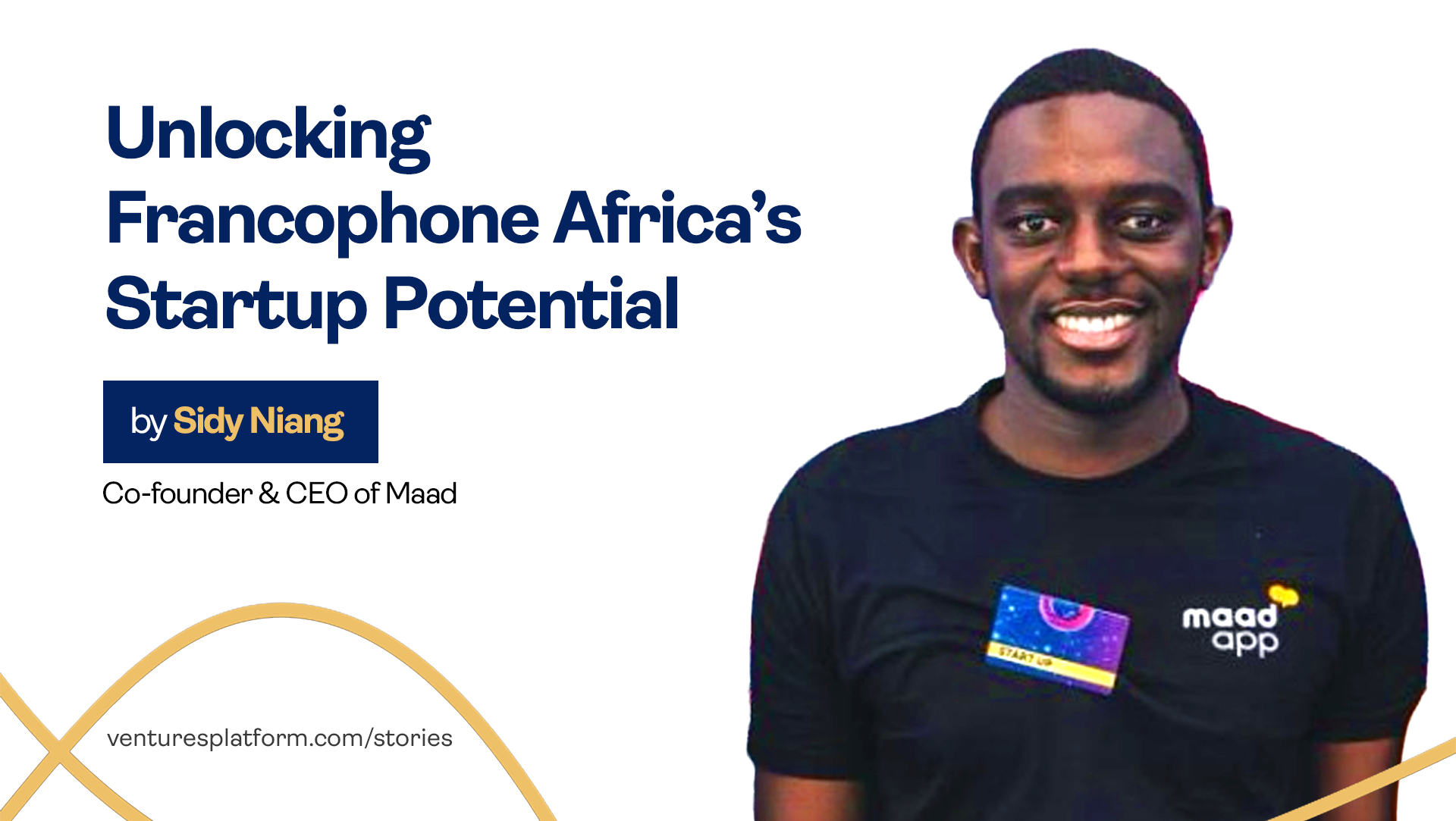
Francophone Africa is quietly becoming one of the most compelling frontiers for entrepreneurship. With nearly 300 million people, roughly 300 billion US dollars in GDP, and several of the fastest-growing and most stable economies in Africa, the region is far more appealing than it appears from the outside. Add to that i) a currency pegged to the euro for decades, ii) low inflation of 2 to 4 percent versus up to 15 percent in Nigeria or Egypt, and iii) a young, rapidly growing population, and the foundations for large, durable businesses are clear.
But to understand the opportunity, we must also acknowledge why investors hesitate: many Francophone countries look small. Senegal has 18 million people. Côte d’Ivoire has 28 million. Lagos or Greater Cairo each exceed 20 million inhabitants on their own. When viewed in isolation, it is understandable that investors question whether these markets can support large outcomes.
This is where the picture becomes more interesting. Francophone Africa is not a collection of isolated small markets. It is one of the most integrated regions in Africa, with a shared language, currency, and similar regulatory frameworks. And because the ecosystem is still early, entire categories remain unclaimed. Founders operate in a genuine blue ocean, with rare opportunities to define markets rather than compete with incumbents.
I have seen both sides of this transition as an investment professional (ex-IFC) and now as the co-founder of Maad. The region is changing fast, and the way founders raise capital is changing with it.
Why VC Has Not Fully Entered Francophone Africa, and Why Founders Struggle to Raise Capital
The first challenge is market size perception.
Even with strong fundamentals, many investors still see Francophone markets as too small to support large outcomes. This first impression limits how many investors are willing to invest time in understanding the model. Hence, the top of the funnel starts smaller.
The second challenge is infrastructure.
Investors often assume that mature logistics networks, reliable fintech APIs, and startup-friendly banks or telcos already exist. In reality, these layers are incomplete or fragmented. Founders frequently need to build full-stack solutions, creating both the product and the underlying rails. For investors used to plug-and-play infrastructure, this raises questions about scalability and capital efficiency.
The third challenge is investor education.
Because fewer investors know the region well, founders spend considerable time explaining why distribution is full-stack, why payments require new rails, and why integrations cannot simply be done “via API.” Without this context, investors default to surface-level heuristics, usually population size or comparables from other markets, which do not reflect how products should be built in these markets.
The fourth challenge is startup readiness
For many years, a significant number of startups in the region simply did not meet the level of readiness that investors look for. Metrics were not strong enough, materials were not meeting certain standards, and the overall storytelling lacked ambition. Too many companies framed themselves as “good for Francophone Africa,” instead of presenting a credible plan to build a large, scalable business.
Wave’s 200 million dollar Series A shifted these assumptions.
It demonstrated that a company headquartered in a Francophone market could reach unicorn scale while operating mostly in one country. It showed that deep penetration and strong execution can outweigh perceived market-size constraints. After Wave, investors began to update their mental models, and founders across the region raised their level of ambition accordingly.
The Strategies Emerging in Francophone Africa to Build a Large Company
Francophone founders are increasingly relying on three clear paths to scale:
1. Go deep in one core market (“boil the lake”)
Depth can outweigh population size. If a company reaches most of the economic actors in a country directly or indirectly, it can create enormous value even in a 10-million-person market. Wave proved this in Senegal. Djamo is doing it in Côte d’Ivoire.
At Maad, we crossed 65 million dollars of annualized GMV while operating only in one City, Dakar (3 million people). Penetration, touching many lives and most of the market, is what creates defensibility and scale.
2. Expand across Francophone Africa
Shared language, currency, and similar market structures make replication far easier than many assume. A model that works in Abidjan often works in Dakar, Bamako, or Lomé with limited adaptation. Socium is a strong example, now operating in five markets with over 500 corporate clients.
3. Refine in Francophone Africa, then expand into the largest markets
The next wave of startups will use Francophone markets as efficient testing grounds, similar to Estonia or Israel, then enter the largest Markets. This trend is already visible with several Senegalese startups starting to expand outside of Francophone Africa, e.g., Wave, with penetration into a few non-French-speaking countries in Africa and on a strong trajectory to capture the French diasporan base outside of the continent via other complementary verticals.
What Francophone Founders Must Do to Attract Capital
Operate at global standards.
Use English across all materials. Present clear metrics. Build a team, product, and traction that could raise money anywhere.
Provide context, then let traction speak.
Explain why full-stack models are necessary and how scale emerges. But ultimately, investors respond to performance.
Show how smaller markets become large opportunities.
Demonstrate deep penetration, multi-country replication, and a credible path to expanding into larger ecosystems.
Looking Ahead: Francophone Africa as a Launchpad
The next generation of major outcomes will not be confined to Francophone Africa. They will start here, in markets where discipline, full-stack execution, and market depth are tested early, and then expand outward into the largest African and global markets.
Founders in this region build under unique constraints. They operate with less capital, less infrastructure, and fewer ready-made tools. These conditions create resilience, precision, and a honed ability to solve fundamental problems. Companies that succeed here are, by necessity, exceptionally strong.
Francophone Africa is no longer a peripheral ecosystem. It is becoming a launchpad. For investors willing to engage early, the opportunity is far larger than headline population numbers suggest.
Small markets become big markets when you touch many lives. Wave showed it. Others are proving it. Many more will follow.
Author
Sidy Niang, Co-Founder & CEO, Maad
